
Study in Germany Without IELTS Is It Possible in 2026?
3 March 2026
Canada PGWP Changes 2026 Who Is Eligible Now?
6 March 2026Study in Germany Without IELTS Is It Possible in 2026?
3 March 2026Canada PGWP Changes 2026 Who Is Eligible Now?
6 March 2026Study in Germany Without IELTS Is It Possible in 2026?
3 March 2026Canada PGWP Changes 2026 Who Is Eligible Now?
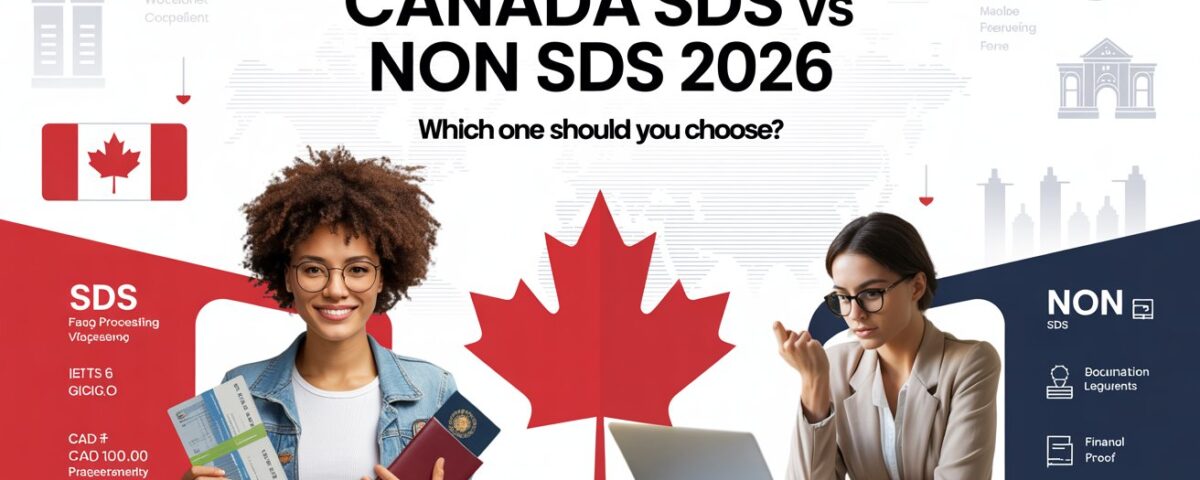
6 March 2026SDS is basically a speedy visa processing option from Immigration, Refugees and Citizenship Canada (IRCC). It’s designed for students from certain countries and rewards those who can prove strong finances and language skills.
If you’re from India, Pakistan, Philippines, Vietnam, Nigeria, China, Morocco, or Senegal and you meet the requirements, SDS gets you a quicker decision than the regular process.
The IRCC sets some clear rules for SDS.
You need at least 6.0 overall in IELTS Academic, with no band below 6.0.
(They sometimes accept other tests like CELPIP, PTE Core, or TOEFL. Check the current IRCC list.)
You have to buy a CAD 10,000 GIC from an approved Canadian bank.
Examples include
Scotiabank
ICICI Bank Canada
CIBC
SBI Canada
This shows you’ve got living expenses covered for your first year in Canada.
Pay the entire first year tuition and show proof.
Get an official Letter of Acceptance from a Designated Learning Institution (DLI).
Take your medical test before you send in your application.
Non SDS is basically the backup route for students who don’t meet all the SDS requirements.
Maybe your IELTS score falls a little short, you cannot pay the whole year’s tuition right away, or you don’t have a GIC.
That’s fine. You can still apply through Non SDS.
Just be ready to deal with more paperwork and make your Statement of Purpose (SOP) really count.
Non SDS gives you a bit more flexibility, but it requires more documentation.
Usually, you’ll need at least a 6.0 overall in IELTS, though the band scores can shift depending on the program.
Other accepted tests may include
PTE Academic
TOEFL iBT
Duolingo English Test (if your college accepts it)
Instead of a GIC, you’ll show financial documents such as:
Bank statements from the last 6 to 12 months
Income tax returns
Sponsor documents
Fixed deposits
Education loan approval letters
You don’t have to pay the whole year’s tuition.
Sometimes just the first semester or a partial payment is enough (depending on the college).
This is your chance to explain your study plans, why you picked your course, and your career goals.
It becomes especially important in Non SDS applications.
Fast processing
Mandatory IELTS 6.0 in each band
GIC required
Full one year tuition paid
Fewer documents
Slower processing
Flexible language scores
No GIC required
Partial tuition payment allowed
Requires detailed financial documents and a strong SOP
It comes down to your own situation.
You have IELTS 6.0 in each band
You can pay the full tuition fees
You can arrange the CAD 10,000 GIC
You want faster visa processing
Your IELTS score is lower
You cannot pay the full tuition upfront
You have strong financial support from a sponsor
Your college allows flexible payment options
Both routes lead to the same outcome (a Canadian Study Permit). It simply depends on your eligibility and financial readiness.
Canada has made some changes recently, and students should be aware of them.
IRCC has introduced a cap on study permits
Authorities are checking more carefully whether students are genuine
Financial documents are being examined more closely
Public colleges and universities are receiving more preference
Because of this, it’s important to choose courses that lead to strong career opportunities.
Fields that still show good demand in Canada include
Healthcare
Skilled trades
Engineering
Construction
Agriculture
Technology
Both SDS and Non SDS are valid pathways to get a Canada study permit in 2026.
The key is to choose the route that fits your academic profile and financial preparation and make sure your documents are properly prepared before applying.